
The Critical Minerals Reckoning
Why the World's Most Important Supply Chains Run Through Beijing
When 4M Group's John Walker, Senior Managing Director and Global Head of Battery & Clean Tech, spoke at a recent MeetPerry virtual event on critical minerals, he didn't sugarcoat the math. His assessment of the West's position in the race for critical mineral supply chains was blunt, data-driven, and uncomfortable.
The core thesis: the US and its allies are decades behind China in securing the materials that underpin every major technology investment of the next century, from semiconductors to batteries to defense systems. And closing that gap won't be quick, cheap, or easy.
China's Playbook: Control the Refinery, Control the Market
The numbers tell a story that goes well beyond mining. China holds roughly 7-8% of the world's lithium reserves. That's a modest share. But through decades of patient, state-backed investment across Africa, South America, and Australia, Beijing has built something far more valuable than mines — it has built the bottleneck.
Chinese companies now control approximately 65-80% of global lithium refining capacity, 77% of battery cell manufacturing, and over 90% of graphite processing. According to the US Energy Information Administration, Chinese firms command roughly 85% of the world's battery cell production capacity by monetary value. The CSIS estimates that across lithium, cobalt, and copper, China controls between 40% and 90% of global processing capacity, despite producing only about 10% of the raw material.
Walker's characterization at the MeetPerry event was direct: China secured this position through strategic investments in lithium-rich regions, locking up supply at the source while building out the refining infrastructure the rest of the world neglected. His estimate that the US needs 20 years to match China's refining capacity aligns with the broader consensus, Columbia University's Center on Global Energy Policy notes that it takes an average of 29 years to bring a mine from exploration to production in the United States.
As Walker put it bluntly: "You'll never slow them down."
Washington's Response: Playing Catch-Up at Scale
The urgency is now bipartisan and escalating. In February 2026, the State Department hosted 54 countries at the Critical Minerals Ministerial, the largest gathering of its kind, with Vice President Vance, Treasury Secretary Bessent, and Energy Secretary Wright all in attendance. The centerpiece: a proposed preferential trading zone for critical minerals with enforceable price floors, designed to create a protected market that excludes Chinese and non-member participation.
The EXIM Bank approved a $10 billion direct loan for "Project Vault", establishing a US Strategic Critical Minerals Reserve, more than double the largest financing in its history. Across the broader critical minerals portfolio, EXIM has issued $14.8 billion in Letters of Interest, including $400 million for lithium extraction in Arkansas and $455 million for rare earth processing domestically.
In January 2026, Trump signed an executive order titled "Adjusting Imports of Processed Critical Minerals," explicitly acknowledging that mining alone doesn't solve the problem, it's the refining and processing that matters. The EO directs the Commerce Secretary to negotiate supply agreements with allied nations and contemplates tariffs if those negotiations stall.
The scale of investment is real. The question is whether it's enough, and whether it's fast enough. Investment in critical minerals grew just 2% in real terms in 2024, down from 14% in 2023. Western mining operations face higher costs, longer timelines, and limited resilience during commodity price downturns. China's model, by contrast, treats mineral processing like strategic infrastructure: low-return, state-backed, and designed for long-term control rather than quarterly earnings.
The Spruce Pine Problem: One Town, One Road, $600 Billion at Stake
Walker's most striking example at the MeetPerry event cut to the heart of supply chain fragility, and it wasn't about lithium at all.
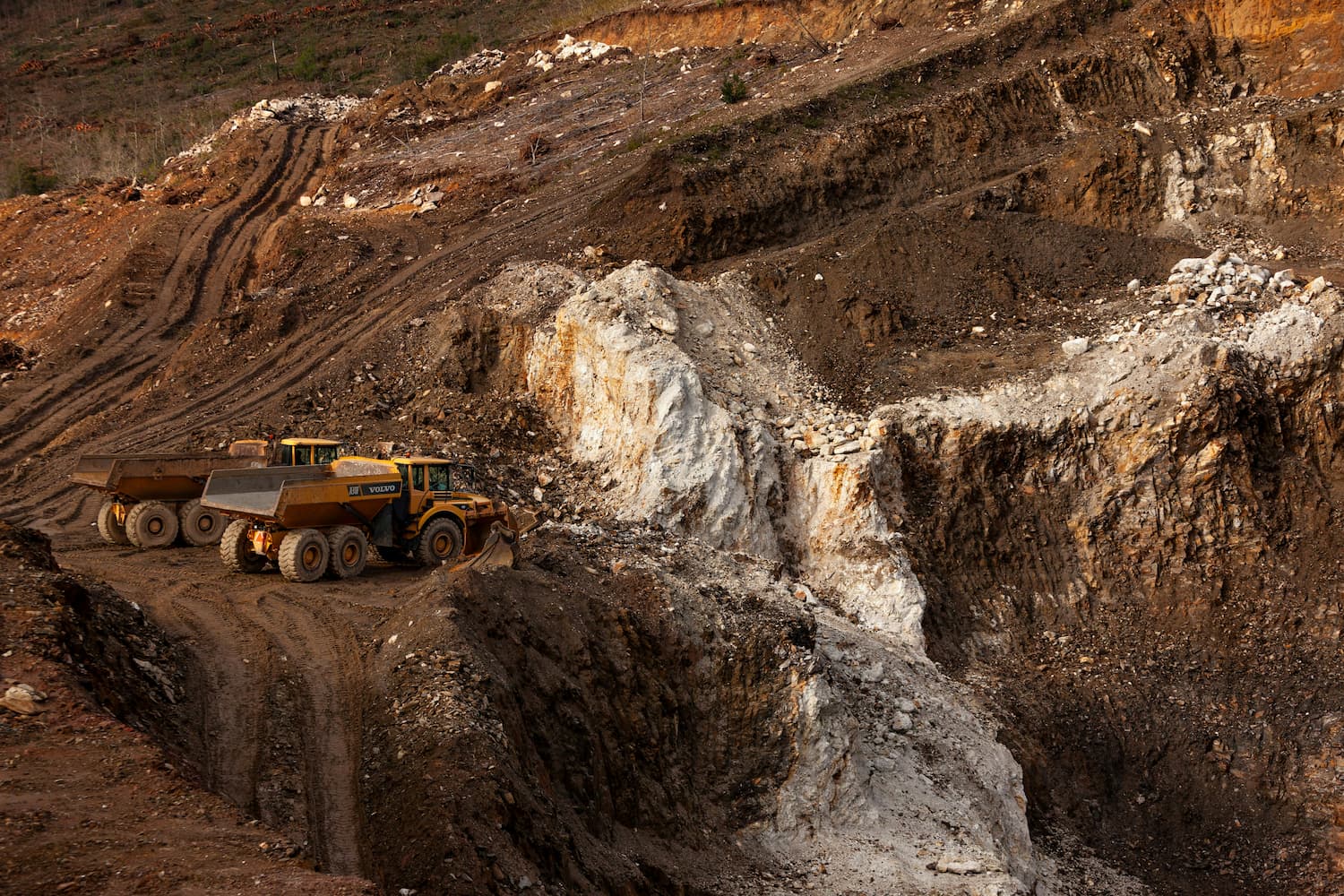
Spruce Pine, North Carolina. Population: 2,194. This single town, nestled in the Blue Ridge Mountains, produces between 80% and 90% of the world's high-purity quartz, the material essential for manufacturing the crucibles used to produce silicon wafers, which become semiconductor chips and solar panels.
As Walker told MeetPerry members: "Spruce Pine high-purity quartz production supports the entire world's semiconductor and solar industry. Without the mines in the small town of Spruce Pine, North Carolina, it would have a significant global impact."
The geological reality is unique. Spruce Pine's deposits formed 380 million years ago during the collision of Africa and North America, creating quartz of unparalleled purity due to extreme heat in the absence of water. There is no known alternative source at comparable quality and scale.
This isn't theoretical risk. When Hurricane Helene hit in 2024, it devastated the town, destroying roads and infrastructure and halting production at the two mines, operated by Sibelco and The Quartz Corp, that supply the global semiconductor industry. TSMC, Samsung, and Infineon all issued statements monitoring the situation. CNBC reported that the shutdown raised concerns about crippling a $600 billion global industry. One mine manager told the BBC that nearly every cell phone and computer chip contains silicon derived from Spruce Pine quartz.
Sibelco has since announced $700 million in expansion investment, including $200 million to double high-purity quartz capacity. But the fundamental vulnerability remains: a single point of failure for one of the most critical supply chains on earth.
What It Means for Investors
Every metal on the US Critical Materials List will face supply constraints for decades. That's not a speculative thesis, it's the mathematical consequence of demand growth colliding with concentrated supply.
Lithium demand jumped nearly 30% in 2024 according to the International Energy Agency, driven by EV production and grid-scale battery storage. AI data center expansion is adding new demand pressure on copper, aluminum, and rare earths. Energy-storage batteries are projected to account for nearly one-third of global lithium demand in 2026, up from just under a quarter last year.
Meanwhile, China has begun restricting exports. Since 2023, Beijing has implemented export controls on gallium, germanium, and antimony, minerals critical to semiconductor and defense applications. In early 2026, reports emerged of China curbing rare earth exports to Japanese firms after dual-use technology bans. These aren't hypothetical levers, they're being pulled now.
The investment implications cut across sectors. Critical mineral supply chain risk isn't confined to mining stocks or battery manufacturers, it's embedded in semiconductors, defense, clean energy, automotive, and any technology that requires advanced materials. Portfolio managers who treat this as a niche energy-sector allocation may be underestimating how deeply these constraints run.
Walker's message at MeetPerry was clear: the institutions that understand this dynamic early will have a structural advantage. The ones that don't will discover it the hard way — the next time a hurricane hits a small town in North Carolina, or Beijing decides to tighten the valve.
Related News

